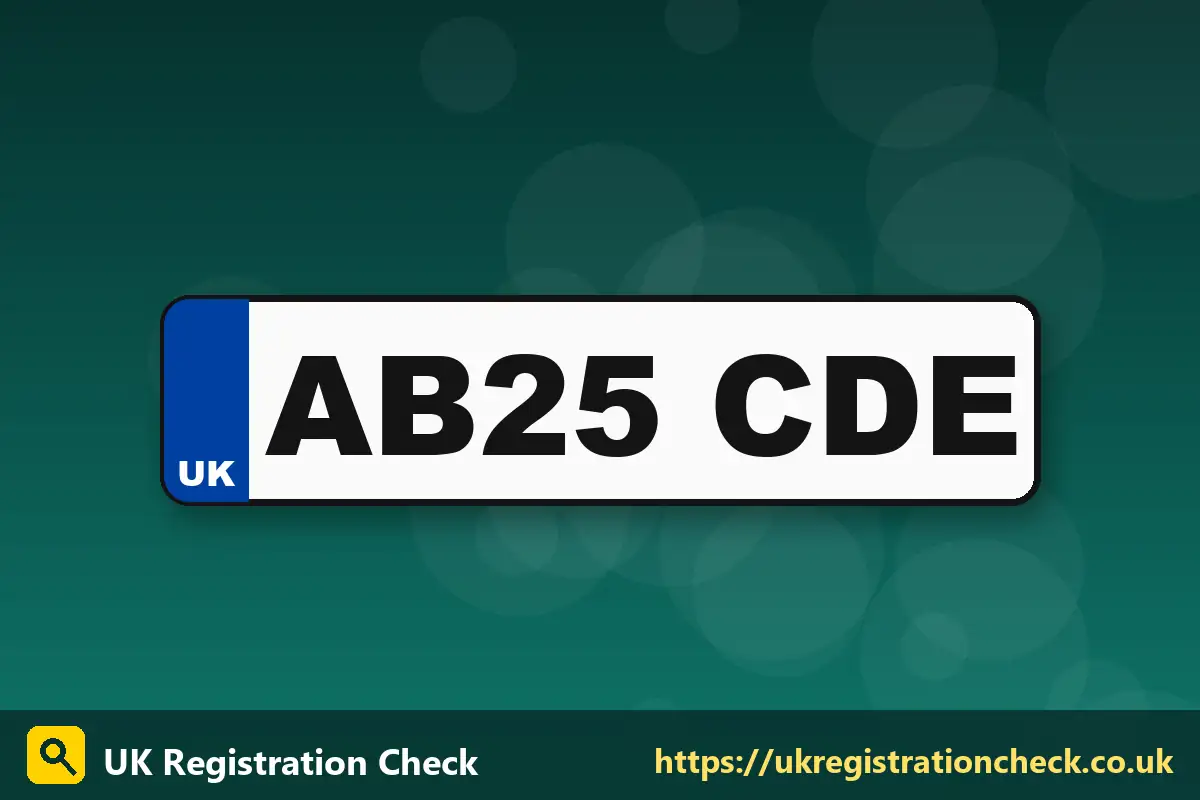
To read a UK number plate, split the registration number into its parts: two letters (the memory tag), two digits (the age identifier) and three random letters, as in AB25 CDE. The memory tag tells you broadly where the vehicle was first registered, the digits tell you roughly when, and the last three letters simply make the combination unique. This is the current style number plate, issued by the Driver and Vehicle Licensing Agency (DVLA) since September 2001.
Part of Number Plate Checks. Start with the main guide: Number Plate Check: Free UK Reg Lookup
Updated October 2026 · Independent information, not legal advice
Older cars, personalised plates and Northern Ireland registrations follow different patterns, so the same skill does not always work. What follows is a UK number plate explained step by step: the full decoding method, the March and September age rule with worked examples, what earlier formats looked like, and the limits of what any plate can reveal about a vehicle.
What Is The UK Number Plate Format?
The UK number plate format in use today is two letters, two digits, a space and three letters, issued by the DVLA for vehicles first registered in Great Britain from September 2001.
| Part | Characters | What it tells you |
|---|---|---|
| Memory tag | AB | Region and local DVLA office of first registration |
| Age identifier | 25 | The registration period, not an exact date |
| Random letters | CDE | Nothing; they only make the number unique |
| Space | (gap) | Separates the date part from the random part |
Why is it called a current-style number plate?
Because it replaced the prefix system, where the year letter came first. Anything issued since the autumn of 2001 follows this layout, and it is still being issued today.
How many characters can a plate have?
A standard current-style plate has seven characters plus the space. Personalised plates on older formats can be shorter, which is why a short plate is usually a dateless or cherished one.
What Do The Letters On A Number Plate Mean?
The letters on a number plate mean two different things: the first two are a location code, and the last three are random. Anyone asking what do the letters on a number plate mean, or looking for number plate letters meaning in general, is usually after the first pair, since the final three carry no information at all.
The memory tag: first two letters
The memory tag is a two-letter code in which the first letter marks a DVLA region and the second narrows it to a local office within that region. It is called a memory tag because the codes were meant to be easy to remember, such as L for London or S for Scotland.
The random letters at the end
The last three letters are generated by the DVLA to give each registration a unique combination. They do not encode the make and model, the engine, the keeper or the vehicle identification number (VIN).
Letters you will rarely see
Some letters are held back from the random section, so you will not meet certain combinations. The DVLA decides the allocation, and the full detail is on GOV.UK.
How Does The Age Identifier Work?
The age identifier is the pair of digits after the memory tag, and it changes twice a year. On 1 March it becomes the last two digits of the year; on 1 September it becomes the year plus 50.
The March and September rule
Between March and the end of August the digits are simply the year, so 25 means registered between March and August 2025. From September to the end of February the digits are the year plus 50, so 75 means September 2025 to February 2026.
Worked examples: 25, 75, 26 and 76
- 25: registered March to August 2025.
- 75: registered September 2025 to February 2026.
- 26: registered March to August 2026.
- 76: registered September 2026 to February 2027.
Dealers and buyers often wait for these changes, which is why new plate day in March and September is busy. If the date matters to you, see when the 25 plate comes out and when 75 plates come out.
Does the plate show the exact registration date?
No. It shows a six-month window. For the precise first registration month, the official DVLA Vehicle Enquiry Service shows the month and year of first registration for many vehicles.
How To Read A UK Number Plate Step By Step
Reading a plate takes four steps, and it works best on a plate with two letters and two digits.
- Look at the first letter and second letter: the memory tag for region and office.
- Read the two digits: below 51 it is March to August of 20 plus the digits; 51 and above, subtract 50 for a September to February period.
- Ignore the last three letters, as they are random.
- Check that the result matches the vehicle: its body style, lights and wheels should fit the age you worked out.
How Do Number Plates Work In The UK In Practice?
How do number plates work UK-wide is simple in law: every road vehicle is registered by the DVLA, the registration number is recorded against it, and the plate must show that number. The number is then used for vehicle tax, the MOT history and enforcement cameras.
Where the registration number is recorded
The registration appears on the V5C logbook, in the MOT history published by the Driver and Vehicle Standards Agency (DVSA) and on the DVLA's vehicle records, linked to the registered keeper.
Front and rear plates
The front plate is white and the rear plate is yellow, both with black characters. Motorcycles usually need only a rear plate, so check GOV.UK for your vehicle type.
What Did Older Number Plate Formats Look Like?
Before 2001 the registration number followed two older formats, plus dateless ones that show no age at all.
Prefix plates (1983 to 2001)
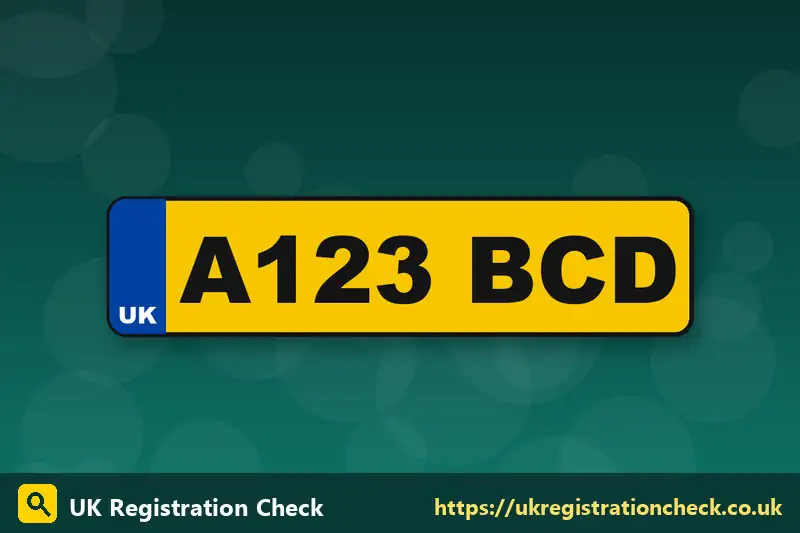
A prefix plate starts with a year letter, for example A123 BCD. The letters ran roughly from A in 1983 to Y in 2001, and a number such as this tells you the era but not the month.
Suffix plates (1963 to 1983)
A suffix plate ends with a year letter, such as ABC 123A. Registrations from before 1963 are mostly dateless-style combinations, covered further in dateless number plates.
Dateless and cherished plates
A dateless plate has no year letter, so the plate cannot reveal the vehicle age. These are often sold as cherished registrations and can be moved between vehicles, which is why a short plate rarely matches the car it sits on.
Can A Number Plate Be Misleading?
Yes. A personalised plate may be assigned to a vehicle of any age, provided it does not make the vehicle look newer than it is. A car showing a dateless plate or an older-style plate may therefore be many years younger or older than the plate suggests.
Age-related plates and the DVLA rule
The DVLA does not allow a registration number that makes a vehicle look newer than it is. Conditions can change, so read the rules on GOV.UK before moving a number between vehicles.
Cloned and false plates
A plate that does not match the vehicle is a warning sign. A mismatch between plate, make and model, colour or V5C is worth a proper vehicle check before buying, and fake or cloned plates can lead to prosecution.
What Can A Number Plate Not Tell You?
A plate is only a label, so it does not show who owns the vehicle, whether it is insured or what has happened to it in the past.
- The registered keeper, who is protected personal data.
- Insurance, finance, write-off or stolen markers.
- The VIN or chassis number.
- Service history and the number of previous keepers.
Why the VIN matters more than the plate
The VIN is stamped on the chassis and printed on the V5C. For how it is built, see the vehicle identification number explainer.
How Can You Check What A Plate Really Belongs To?
The quickest way is to enter the registration into the free number plate check, which returns make and model, colour, fuel, MOT status and expiry, tax status and the year of first registration from official DVSA and DVLA records.
If the details on screen do not match the car in front of you, treat it with caution and ask to see the V5C logbook. A broader comparison is set out in free vs paid vehicle checks.
Do Motorbikes, Vans And Electric Vehicles Use The Same Format?
Yes, the same registration format covers every road vehicle registered in Great Britain, whatever the type.
Motorcycle plates
A motorbike carries a plate in the same structure but usually only at the rear, in a smaller size. See motorbike number plates for the rules.
Electric vehicles
Zero-emission vehicles may display a green flash on the plate, but the registration number itself follows the same layout.
What About Northern Ireland And Irish Plates?
Northern Ireland plates use a different pattern, usually letters (including I or Z) followed by numbers, and carry no age identifier. Vehicle registration and tax in Northern Ireland still sit with the DVLA, while testing is run by the DVA.
Plates from the Republic of Ireland
Irish plates start with a year code, then a county code and a serial number. They are a separate system, so see Irish number plates for how to read one.
Common Mistakes When Reading A Plate
Most errors come from applying the current-style rules to the wrong kind of plate.
- Reading the last three letters as a code. They are random.
- Treating a dateless plate as a clue to age.
- Forgetting the plus 50 rule after September, so 75 is mistaken for 1975.
- Assuming the memory tag shows where the owner lives today. It shows where the vehicle was first registered.
- Trusting the plate over the V5C logbook and MOT history.
Which Parts Of The Plate Matter To A Buyer?
For a used-car buyer, the age identifier and the matching vehicle details matter most.
- The age identifier, to confirm the car is the age the seller claims.
- The make and model on record, to confirm the plate belongs to that car.
- The MOT history and tax status, which are tied to the registration.
- Evidence that the plate was not swapped to hide a past, which a full history check can show.
Quick Checklist For Reading Any Plate
- Count the characters and spot the pattern: two letters, two digits, three letters.
- Decode the digits with the March and September rule.
- Treat short or dateless plates as no evidence of age.
- Compare the plate with the V5C, the make and the MOT history.
- Confirm the details with the official lookup.
Is The Age Identifier The Same As The Age Of The Car?
Not always. The identifier reflects the first registration date, so a car imported later can show a newer identifier than the year it was built, and an old vehicle can carry a transferred plate.
- A grey import is registered when it arrives, not when it was built.
- A rebuilt classic may keep its original registration.
- A transferred plate can change what the vehicle displays, within DVLA rules.
Where Is The Official Source?
The official rules on registration numbers, age identifiers and displaying plates are published by the DVLA on GOV.UK. A complete list of memory tags is also held there, so use it for the final word.
Frequently Asked Questions
How do I read a UK number plate?
Split a current-style plate such as AB25 CDE into three parts. The first two letters are the memory tag, which shows the region and local DVLA office. The two digits are the age identifier, which shows the six-month period of registration. The last three letters are random and mean nothing. Older plates follow prefix, suffix or dateless formats instead.
What do the letters on a number plate mean?
Only the first two letters carry meaning. The first points to a DVLA region and the second to a local office within it. The three letters at the end are random and only exist to make each registration unique. On a prefix or suffix plate, a single year letter shows the era.
What does the 25 on a number plate mean?
The digits 25 mean the vehicle was first registered between 1 March and 31 August 2025. The September counterpart is 75, which covers September 2025 to the end of February 2026. Because it is a six-month window, the plate alone cannot show the exact month, but the official vehicle lookup can show the first registration date for many vehicles.
How do I work out the year from a number plate?
If the two digits are below 51, add 2000 to get the year, covering March to August. If they are 51 or higher, subtract 50 and add 2000, covering September to the end of February the following year. For example 76 means September 2026 to February 2027.
Why is it called a memory tag?
The two letters at the start were designed as an easy-to-remember location code, so the term memory tag stuck. The first letter marks a DVLA region and the second a local office. The full list is held by the DVLA and published on GOV.UK, so check there rather than relying on guesswork.
Can a number plate show who owns a car?
No. A registration number is linked to the registered keeper in DVLA records, but that is protected personal data released only for legitimate reasons under strict rules. A plate cannot be used to find an owner, and no free check will show names or addresses.
Does every vehicle have the same number plate format?
Most road vehicles registered in Great Britain since 2001 follow the current style. Older vehicles may have prefix, suffix or dateless plates, and Northern Ireland and Republic of Ireland plates use different patterns. Motorcycles use the same structure but usually display a rear plate only.
Can I tell a car's age from a private plate?
Not reliably. A private plate can be assigned to a different vehicle, so the age shown may not match the vehicle. The DVLA does not allow a number that makes a vehicle look newer than it is, but it can look older. Check the year of first registration with the lookup instead.
How can I check a number plate is genuine?
Enter the registration into a free lookup and compare the make, model and colour with the car. Then check the MOT history and ask to see the V5C logbook. If anything does not match, walk away or take a fuller history check before paying.
Official Sources
Rules, fees and deadlines change. Confirm anything that affects your money or legal position with the official service.